BPS awards JR Vane Medal to Professor Tony Harmar

The British Pharmacological Society today announced the winners of several of their 2014 awards and prizes. Among these awards is the JR Vane Medal which has been awarded posthumously to Professor Tony Harmar. This award reflects the tremendous contribution Tony made to the field over his lifetime as a researcher, founder and chair of the IUPHAR Database (now the IUPHAR/BPS Guide to PHARMACOLOGY), and Professor of Pharmacology at the University of Edinburgh.

The award for BPS Australasian Visitor has been awarded to Professor Anthony Davenport of the University of Cambridge, Vice Chair of NC-IUPHAR and Chair of the Evolving Pharmacology group.

More information and details of the other BPS awards can be found on the Society’s site at this link.

Posted in Uncategorized

Will the real drugs please stand up? Case studies in chemical curation I

Our database now contains over 6500 ligands, spanning 7 chemical classes. An important part of our curation work is to ensure the chemical structures of these ligands are accurate through both careful curation of new ligands and the running of quality control checks on existing ligand structures. In a series of blog posts over the coming weeks we will discuss some case studies from our recent chemical curation work. These case studies were encountered when we worked on a dataset provided by the PubChem team, which involved quality control checks based on cross-referencing between our ligands and their corresponding CID-assigned entries on PubChem. The GtoPdb team are working on adding links to PubChem from all our ligand pages via CIDs therefore we are trying to ensure there is a consensus between the two resources on the structures of our ligands, and that in cases where a compound has been assigned multiple CIDs or is available in different preparations that our choice of curated structures and links, and where relevant supporting comments, reflects this. The topic of this post is discussed in further detail by our team member Chris Southan on his blog and recent poster.

Cross-referencing of lists of INN-assigned compounds between GtoPdb and PubChem revealed there were some mismatches in the specified stereochemistry, and in some cases nomenclature, of the INN-assigned compounds. In other cases, the structures for our ligands agreed with PubChem but the curated CIDs on the ligand pages pointed to PubChem entries with different stereochemistry, or in one instance with a slightly different structure. In order to resolve these differences, we completed cross-checking between our structures, those specified by FDA labels, INN documents and other resources, and the ‘consensus structures’ on PubChem. For readers unfamiliar with the term ‘consensus structure’, this refers to the CID entry on PubChem with the highest number of same structure matches in terms of SIDs for reported bioactivity data. We aim to link to the PubChem entry which has the highest number of same structure matches reported in bioactivity data references. However, in exceptional cases, the consensus structure on PubChem may not match our structure.

Following a review of each of our flagged ligand entries, we made a decision to either add a curators’ comment to our ligand entry explaining any differences between the resources, or where necessary make revisions to the chemical structure, ligand name or PubChem CID links included on the ligand page. This exercise revealed some ambiguities in several chemical structures and posed the challenge of deciding how they are best represented in databases. Some of the issues that arose during the course of this project were already familiar to the team while others were encountered for the first time during this exercise. We are working on devising protocols for our chemical curation methods which some of these case studies will help to define. As usual, we welcome feedback from our users, so please feel free to contact us with any comments you have on the series of posts to follow.

Contributed by Helen Benson

Posted in Chemical curation

New content and features on The Guide to PHARMACOLOGY: our April 2014 update

Last month we updated our site to include the results of our curation efforts since the start of the year. Our main focus of 2014 so far has been curation of approved drugs and clinical targets, and the site has now expanded to include 1000 approved drugs and their ~250 data-supported primary targets. This set represents a minimal set of approved drugs and targets obtained by intersecting and analysing multiple publically available datasets. For those interested in more detailed information on our methods for drug consensus mappings please see this blog post by our team member Chris Southan, and our recent poster on the topic.

The latest release has also seen updates to existing content and new features introduced to the site.

Approved drug and target curation

Our progress since the last update includes:

  • ~300 new approved drugs have been added to the database, including small organics and antibodies. These drugs include all the new FDA approvals of 2013 and 2014, and drugs used in the treatment of Alzheimer’s disease.
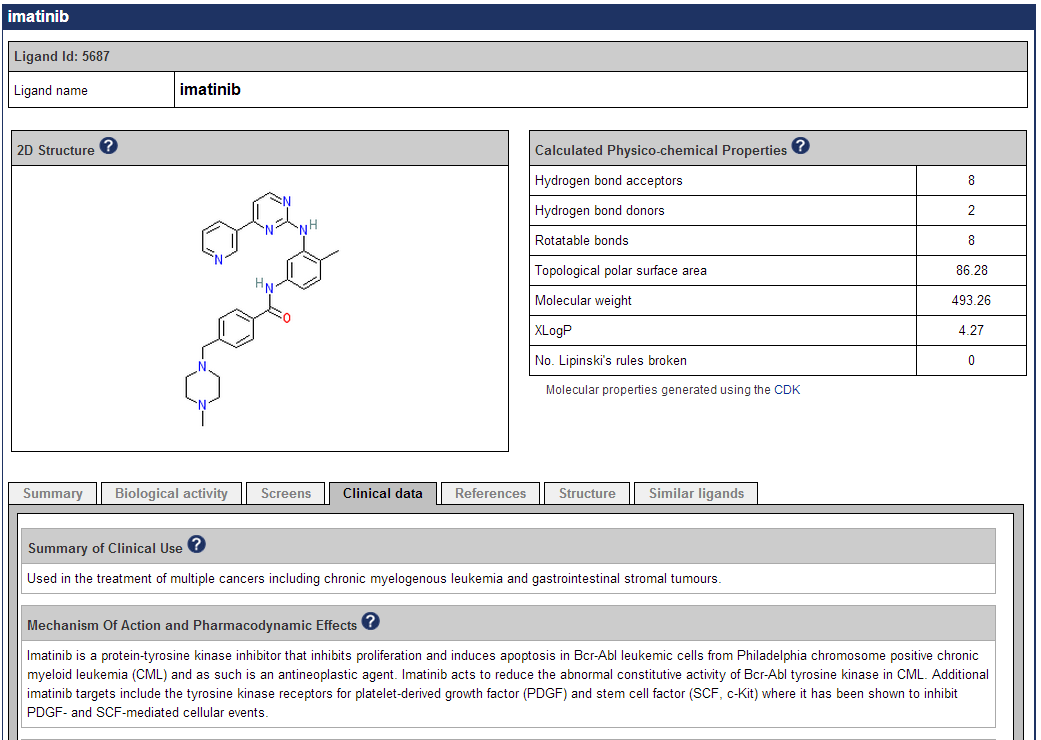
  • Approved drug pages now include approval dates by the FDA/EMA and summaries of clinical use and molecular mechanisms of action (see below).
  • The data-supported primary targets of drugs are indicated with a new symbol ; IC50s and Kis for human targets (or where not available, other mammalian species) have been curated from the literature.
  • New targets include chromatin modifying enzymes, bromodomain-containing proteins, ribosomal factors and kelch-like proteins.
  • Pathophysiological phenotype information and links to OMIM and Orphanet databases added for more targets.
  • High specificity call-outs from ligand pages to PubMed clinical trial reports. N.B. the use of call outs for users offers an instant update from PubMed as opposed to a static link.
  • Annotation of, and cross-linking between prodrugs and their active forms.

Clinical data tab from our Imatinib ligand page

Case study: Drugs and Targets in Alzheimer‘s disease

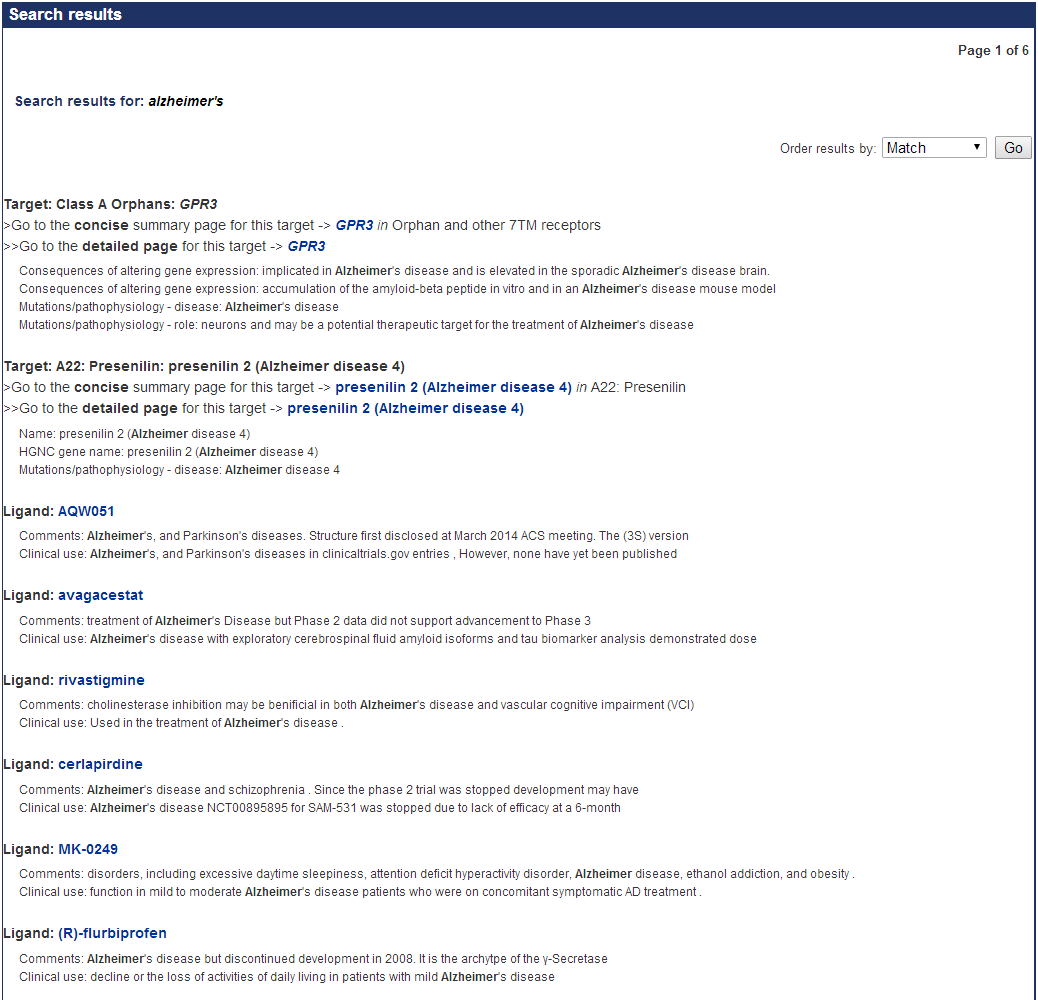
One of our curators, Chris Southan, has completed work on a case study for the curation of drugs and targets involved in Alzheimer’s disease. This project has seen the addition of new approved drugs, compounds in clinical trials and research compounds to the database, all with their pharmacology curated from the literature. The ‘biological activity’ tables and comments for these ligand pages now include patent data in cases where there are SAR data for compounds or analogues. Our database can also now be searched by disease name to retrieve ligand and target pages. Here’s an example of a search using the term ‘Alzheimer’s’:

Results page from using ‘Alzheimer’s’ as a search term

Updates to other content 

Our latest database update also saw new information added to several of our existing target pages:

  • Updated GPCR target pages: bombesin, bile acid, angiotensin, LPA & S1P family pages
  • Updated introduction for formylpeptide receptors
  • Updated content on the voltage-gated calcium channel subunits Cav1.1-1.4 & introduction
  • Cross-links added between GPCRDB and GtoPdb, and the UniProt and HGNC databases now link to GtoPdb.

The database now includes 2655 protein entries and 6653 ligands.

New features

The IUPHAR/BPS Guide to PHARMACOLOGY web portal now incorporates all content from the original IUPHAR Database site including the hot topics and recent pairings pages. The http://www.iuphar-db.org address will be retired over the coming years so be sure to update your bookmarks to the new site.

New file formats have been added to the download page, and complete download files of the database content are now available.

We have also recently set up a Slideshare account.

We are continuing to add approved drugs, clinical candidates and new targets to the site and our next update will be due in the summer, so watch this space and our social media for news of the next release, or sign up for email alerts using the form on our homepage.

Tagged with: , ,
Posted in Database updates, Drug targets

WCP 2014: 17th World Congress of Basic and Clinical Pharmacology in Cape Town

 Image

We recommend that all our users consider attending WCP2014 (early bird registration has now been extended until March 31st). Members of the IUPHAR/BPS Guide to PHARMACOLOGY database team, and NC-IUPHAR committee members will be attending and look forward to meeting you there. A number of presentations by NC-IUPHAR committee and subcommittee members are scheduled, outlined below:

Plenary lectures

  • Arthur Christopoulos-IUPHAR Analytical Pharmacology lecture- Adventures in Allostery: From structure to function
  • Yoshikatsu Kanai – Amino acid transporters in oncology
  • Simon Maxwell – Challenges in training tomorrow’s prescribers
  • Kozo Kaibuchi – Protein Phosphorylation in Signal transduction
  • Richard Neubig – Signal transduction in therapeutics
  • Doriano Fabbro – Tyrosine kinase inhibitors
  • Martin Michel – Autonomic pharmacology of the urogenital tract

Symposia including NC-IUPHAR affiliates

  • Orphan G protein-coupled receptors- What are the new ligand and new drug targets? (Anthony Davenport, Janet Maguire, Stephen Alexander, Adam Pawson)
  • Structural Basis for Ion Channel Pharmacology (including Bill Catterall)
  • NC-IUPHAR and the IUPHAR/BPS Guide to PHARMACOLOGY (Sir Colin Dollery, Michael Spedding, Simon Maxwell, Adam Pawson, Chris Southan)
  • Update in geriatric pharmacology Optimal Prescribing in Older Patients: The challenge of Multiple Comorbid Conditions and Polypharmacy (including Darrell Abernethy)
  • Evolution, sport and modern diseases (including Michael Spedding)
  • Emerging Drug Targets (including Richard Neubig)
  • Glucocorticoids: new insights into mechanisms of action (including John Cidlowski)
  • Epigenetic mechanisms in cell- and drug-based heart failure therapies (including Lutz Hein)

Full details for the meeting and a detailed schedule can be found on the event website. Click on the following links for flyers outlining event speakers, focused target sessions and symposia and events in and around Cape Town.

Posted in Events

Chemical search drawing tools: updating Java and security exceptions

Regular users of the Guide to PHARMACOLOGY will be aware that the site includes a ‘Chemical structure search’ function whereby users can draw chemical structures or parts of structures and use these to search against the database. Users can also paste in a non-isomeric SMILES string copied from another database and use this to search. The chemical drawing function is provided by the Marvin Sketch Java applet from ChemAxon.

In order to use this tool, a recent version of Java is required, and users may find they are prompted to update Java when attempting to access pages running Java applets. However, we have found that the latest version of Java (Version 7 Update 51) on Windows fails to run certain applets, including our chemical drawing tool, owing to enhanced security restrictions. In order to overcome these restrictions you need to add our website address to the Exception Site List for the version of Java your browser is running.

Instructions for how to add site exceptions can be found at this page, under the section “Adding a site to the Exception Site List”. Note that you should add both forms of the website address (http://www.guidetopharmacology.org/ and http://guidetopharmacology.org/).

Other websites we use in our chemical curation work including Scifinder, OSRA and Chemicalize.org also run chemical drawing applets requiring Java therefore users may also wish to add security exceptions for these sites.

Feel free to contact us if you have any questions about the above. We expect in the future to be able to offer a JavaScript version of MarvinSketch which will bypass the Java requirement and should also run on tablet or mobile devices.

contributed by Joanna Sharman and Helen Benson

Posted in Technical

Drug and target lists on the Guide to PHARMACOLOGY

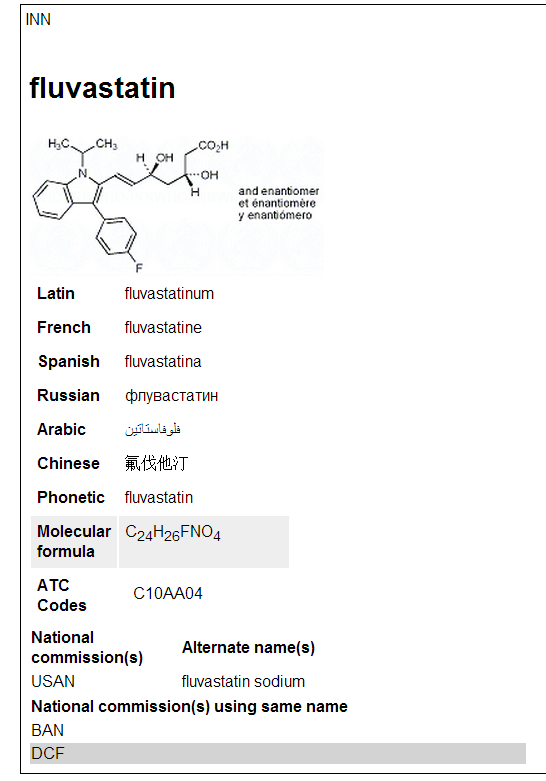
Given the intense interest in drugs and their human targets, both in pharmacology and chemical biology, obtaining a simple list of either is surprisingly difficult. There are many reasons for this. One of them is that those lists that can be obtained vary in which names, synonyms or identifiers are used both on the drug side for the specification of chemical structures and on the target side for the gene/protein. An example of the former is that the INN may be assigned to the parent structure for the approved drug name (e.g. atorvastatin CID 60823), whereas the USAN specifies the salt form (atorvastatin calcium CID 11227182), while the official label for the medication specifies atorvastatin hemi-calcium trihydrate (CID 656846). The target of atorvastatin can be variously designated as Entrez Gene 3156, UniProt P04035, HMGCR or NP_000850. A second reason that makes the exercise challenging are the different “rules” by which any list is populated, either as a published collation or a selectable subset of any particular database. This produces various types of inter-list discordance. Consequently, no independently produced lists agree 100% on either precisely which chemical structures are represented or how these are “mapped” (in the molecular mechanism of action sense) to protein identifiers.

In the course of expanding and enhancing our own database, we have assessed a substantial number of such lists. While we much appreciated their availability, digging these out was non-trivial and we also had to tackle the task of normalising their entity content. This is necessary for comparative analysis and to understand the basis for their overlaps and differences (as described recently in this paper). Given the effort and expertise needed to prepare these lists, we decided to share them with our user community. You can see the result on this page. As ever, feedback is welcome.

contributed by Chris Southan

Tagged with: , ,
Posted in Drug targets